Business Development Bank has executed one of the most rapid and complete transformations in Central Asia, shifting in just three years from a state-directed lending vehicle into a commercially driven, digitally enabled bank serving Uzbekistan’s increasingly dynamic private sector.
The bank operated as Qishloq Qurilish Bank until 2023, effectively functioning as a channel for state programmes rather than a true commercial institution. Its balance sheet was highly concentrated, with 95% of retail lending tied to subsidised mortgages and over half of corporate exposure linked to state-owned or construction-related entities.
For customers, the experience was slow and bureaucratic, defined by manual processes, long approval times and limited access for SMEs or asset-light borrowers. Internally, this created a passive, administrative culture with little commercial focus or capacity for growth.
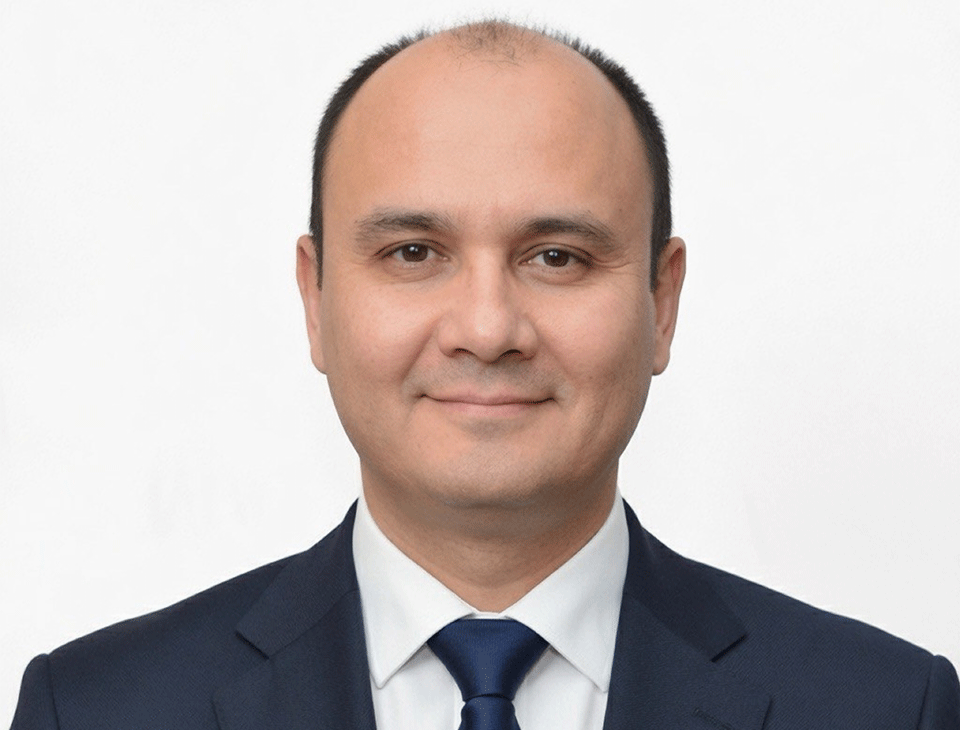
[We] fundamentally reshaped our business model [while building] a modern digital ecosystem to support entrepreneurs across the country
Sakhi Annaklichev
The transformation reset both the business model and the organisation itself. The bank repositioned as a partner for SME growth, pivoting towards diversified, higher-margin commercial activity. Digital capability became central, with platforms such as Biznes 24/7 enabling clients to access services, originate loans and manage accounts remotely.
As CEO Sakhi Annaklichev notes, the bank “fundamentally reshaped our business model,” while building “a modern digital ecosystem to support entrepreneurs across the country”. At the same time, the bank redesigned its credit approach, introducing cashflow based assessment to move beyond rigid collateral requirements, opening access to a broad base of entrepreneurs.
Execution was fast, disciplined and comprehensive. Following rebranding in late 2023, the bank rebuilt its operating core through 2024, establishing internal technology capability and digitising workflows. By 2025, this translated into measurable change. Sixty-one transformation projects were launched, including a redesigned credit conveyor that reduced loan processing times from hours to around 30 minutes, allowing customers to access finance at speed and scale. What had been a paper-heavy, branch-bound process was replaced by a platform capable of delivering rapid, digitally enabled lending decisions.
Cultural shift
The bank also tackled structural issues. Legacy non-performing exposures were reduced through improved monitoring and collection systems, while operational efficiency improved through centralisation and automation. The cultural shift was equally significant. As chief funding officer Ilkhom Khudayberganov explains: “We had to change the culture, working processes and ethics, supported by a structured change programme that combined training with dedicated change agents across the bank.” Performance-based management and extensive capability building helped move the organisation from administrative execution to active client engagement.
The impact on the bank’s performance has been nothing short of transformational. The bank moved from a loss position at the start of 2025 to generate net profit of UZS503 billion ($41.7 million) by early 2026, while improving its cost-to-income ratio to 39.5% and achieving a return on equity of 10.2%. Assets expanded to UZS38.2 trillion, deposits grew strongly and the bank attracted substantial funding from international institutions, reflecting renewed market confidence.
Crucially, the transformation has reshaped the bank’s relevance to the economy. It now serves more than one million clients, including a rapidly expanding base of SMEs, alongside growing corporate and retail relationships.
In a short period, Business Development Bank has moved from the equivalent of a government disbursement desk to a fully functioning commercial institution, capable of supporting entrepreneurship at scale and demonstrating how deeply embedded and well executed transformation can redefine both business performance and purpose.